

Monolithic Refractories for Glass Furnaces and High-Temperature Industrial Applications
Engineered for extreme thermal, mechanical, and chemical environments. Dezhong provides application-matched monolithic solutions—including low-cement castables, gunning mixes, plastics, and precast shapes—designed to eliminate lining joints, resist slag/glass attack, and extend campaign life.
- Technical Support: Custom formulations based on furnace zone analysis
- Testing Standards: Fully compliant with ISO 1927, ASTM C860, and ASTM C133
- Delivery & Shelf Life: Anti-moisture export packaging with up to 12-month shelf life
-
![Corundum Fireclay]() Corundum FireclayCorundum fire putty is a high-performance refractory bonding material made primarily from high-purity alumina. The product exhibits excellent high-temperature resistance.
Corundum FireclayCorundum fire putty is a high-performance refractory bonding material made primarily from high-purity alumina. The product exhibits excellent high-temperature resistance. -
![Sillimanite And Mullite Fireclay]() Sillimanite And Mullite FireclaySillimanite and mullite fire mortar is a refractory bonding material made primarily from sillimanite and mullite, suitable for high-temperature refractory bricklaying.
Sillimanite And Mullite FireclaySillimanite and mullite fire mortar is a refractory bonding material made primarily from sillimanite and mullite, suitable for high-temperature refractory bricklaying. -
![Zirconium Refractory Mortar]() Zirconium Refractory MortarZircon refractory mortar is a refractory bonding material made primarily from high-purity zircon. The product exhibits excellent erosion resistance.
Zirconium Refractory MortarZircon refractory mortar is a refractory bonding material made primarily from high-purity zircon. The product exhibits excellent erosion resistance. -
![Clay Refractory Mud]() Clay Refractory MudClay Refractory Putty is a refractory bonding material made primarily from refractory clay, and it has excellent workability.
Clay Refractory MudClay Refractory Putty is a refractory bonding material made primarily from refractory clay, and it has excellent workability. -
![High Alumina Refractory Mud]() High Alumina Refractory MudHigh-alumina refractory mortar is a refractory bonding material made primarily from high-alumina refractory raw materials, used for refractory brick masonry and furnace lining repair.
High Alumina Refractory MudHigh-alumina refractory mortar is a refractory bonding material made primarily from high-alumina refractory raw materials, used for refractory brick masonry and furnace lining repair. -
![Corundum-mullite Refractory Castable]() Corundum-mullite Refractory CastableCorundum-mullite castable is an unshaped refractory material with corundum and mullite as the main aggregates, possessing excellent high-temperature resistance and high-temperature strength.
Corundum-mullite Refractory CastableCorundum-mullite castable is an unshaped refractory material with corundum and mullite as the main aggregates, possessing excellent high-temperature resistance and high-temperature strength. -
![Steel Fiber Reinforced Refractory Castable]() Steel Fiber Reinforced Refractory CastableSteel fiber reinforced refractory castable is a type of refractory castable in which heat-resistant steel fibers are added, forming an integral refractory structure through casting. The product
Steel Fiber Reinforced Refractory CastableSteel fiber reinforced refractory castable is a type of refractory castable in which heat-resistant steel fibers are added, forming an integral refractory structure through casting. The product -
![Zirconium Corundum Ramming Mass]() Zirconium Corundum Ramming MassZirconium corundum ramming mix is an unshaped refractory material with zirconia corundum as the main raw material, possessing excellent erosion resistance and high-temperature strength.
Zirconium Corundum Ramming MassZirconium corundum ramming mix is an unshaped refractory material with zirconia corundum as the main raw material, possessing excellent erosion resistance and high-temperature strength. -
![Zirconium Ramming Material]() Zirconium Ramming MaterialProducts Description Zirconium ramming material is an amorphous refractory material manufactured using zircon (ZrSiO₄) or electro-fused zircon-corundum (AZS) as the primary aggregate, combined with
Zirconium Ramming MaterialProducts Description Zirconium ramming material is an amorphous refractory material manufactured using zircon (ZrSiO₄) or electro-fused zircon-corundum (AZS) as the primary aggregate, combined with


What Are Monolithic Refractories?
Monolithic refractories are unshaped materials supplied as dry mixes or workable plastics that take their final geometry during site installation. Unlike pre-fired bricks, they eliminate vulnerable mortar joints, creating a continuous, seamless lining.
For glass furnaces and high-temperature reactors, monolithic solutions are ideal for complex geometries, rapid emergency repairs, and high-wear zones requiring targeted material formulations.
Technical Specifications
|
Property |
Standard Castable (Alumina) |
Low-Cement Castable (LCC-80) |
Ultra-Low-Cement Castable (ULCC-90) |
Test Standard |
|
Al₂O₃ Content (%) |
≥ 60 |
≥ 80 |
≥ 90 |
ISO 12677 |
|
Bulk Density (g/cm³) |
2.2–2.4 |
2.8–3.0 |
3.0–3.2 |
ISO 1927-6 |
|
Apparent Porosity (%) |
18–22 |
≤ 14 |
≤ 12 |
ISO 1927-6 |
|
Cold Crushing Strength (110 °C × 24 h) |
≥ 40 MPa |
≥ 70 MPa |
≥ 90 MPa |
ASTM C133 |
|
Cold Crushing Strength (1450 °C × 3 h) |
≥ 50 MPa |
≥ 100 MPa |
≥ 120 MPa |
ASTM C133 |
|
Permanent Linear Change (1450 °C × 3 h) |
−0.3% to +0.1% |
−0.2% to +0.2% |
−0.1% to +0.2% |
ISO 1927-6 |
|
Water Addition (%) |
9–11 |
4.5–5.5 |
3.5–4.5 |
Site Standard |
Material Formulations
Water Addition Control
Adding as little as 1% extra water beyond the specified range increases apparent porosity, reducing cold crushing strength (CCS) by up to 15% to 20% and severely compromising alkali corrosion resistance.
Controlled Dry-out Dynamics
During initial firing, free and chemically bound water transforms into steam. In dense castables, uncontrolled heating generates internal vapor pressure that can cause explosive spalling.
Permeability Management
Formulations must incorporate tailored organic fibers that melt at lower temperatures, creating microscopic vent channels for safe steam evacuation.

Our Monolithic Refractory Range
Refractory Castables (Standard, Low-Cement & Ultra-Low-Cement)
Castables are dry mixtures of aggregate, fine powders, binders, and special additives mixed with water or liquid binders prior to vibration casting.
- Low-Cement (LCC) & Ultra-Low-Cement (ULCC): Engineered with optimized particle packing (micro-silica and reactive alumina) to minimize cement content, resulting in superior hot strength, low porosity, and exceptional resistance to molten glass and slag attack.
- Key Properties: High cold crushing strength (CCS), high modulus of rupture (MOR), and resistance to thermal spalling.
Gunning Refractories
Pneumatically projected onto target surfaces using high-pressure air, gunning mixes allow rapid placement without extensive formwork.
- Performance Drivers: Low rebound rates (less than 10-12%), immediate adhesion, and rapid setting.
- Primary Uses: Hot and cold maintenance, large-area wall repairs, and emergency downtime reduction.
Plastic Refractories
Premixed, highly workable plastic masses installed using air hammers or manual ramming.
- Performance Drivers: Excellent green strength, volume stability under thermal cycling, and high resistance to thermal shock.
- Primary Uses: Furnace burner zones, nose rings, and complex contours where formwork installation is impractical.
Ramming Mixes
Graded aggregates and bonding agents designed for heavy mechanical compaction to achieve maximum bulk density.
- Performance Drivers: Minimal moisture requirement, high resistance to metal and slag penetration, and superior abrasion resistance.
- Primary Uses: Furnace hearths, tapping spouts, and molten glass or metal contact channels.
Refractory Mortars
Air-setting or heat-setting jointing compounds engineered to bond shaped refractory bricks and blocks.
- Performance Drivers: Matched thermal expansion coefficient, fine grain structure for thin joints (less than 1.5 mm), and high chemical resistance.
Precast Refractory Shapes
Factory-cast, vibration-compacted, cured, and pre-baked components manufactured under controlled environmental conditions.
- Performance Drivers: Eliminates site mixing errors, reduces furnace downtime, and guarantees pre-verified physical properties.
How to Select the Right Monolithic Refractory
|
Operating Requirement |
Key Parameters to Review |
Recommended Refractory Type |
|
Extreme Thermal Load |
Refractoriness under load (RUL), creep resistance |
High-Purity Corundum / AZS Castables |
|
Molten Glass Attack |
Chemical compatibility, apparent porosity, phase stability |
Dense Chrome-Alumina or AZS Castables |
|
Slag & Chemical Attack |
Slag resistance testing (ASTM C874), matrix composition |
Low-Cement Alumina-Spinel Castables |
|
Mechanical Wear & Gas Erosion |
Abrasion loss (ASTM C704), bulk density, CCS |
High-Density Abrasion-Resistant Castables |
|
Thermal Cycling |
Thermal shock resistance, thermal expansion coefficient |
Andalusite or Mullite-Based Formulations |
|
Rapid Hot Repair |
Adhesion strength, rebound percentage, setting time |
Specialized Gunning or Ramming Mixes |

- Cold Crushing Strength (CCS) & Modulus of Rupture (MOR) [ISO 1927-6 / ASTM C133]: Evaluates mechanical load capability after drying (110 degrees C) and firing at operating temperatures.
- Refractoriness Under Load (RUL) [ISO 1893]: Determines deformation behavior under combined high thermal and mechanical stress.
- Permanent Linear Change (PLC) [ISO 1927-6]: Measures dimensional shrinkage or expansion after high-temperature firing to ensure structural lining stability.
- Abrasion Resistance [ASTM C704]: Quantifies volumetric material loss from high-velocity particle impact.
- Chemical & Corrosion Resistance [ASTM C874]: Simulates slag or molten glass contact to evaluate matrix penetration and grain dissolution rates.
Quality Control, Packaging, and Export Logistics
Quality Assurance (QA/QC)
- Raw Material Control: Spectral chemical analysis and laser diffraction particle size verification for every batch of aggregates and reactive powders.
- Traceability: Batch-specific identification numbers linked to raw material records, laboratory test reports, and dispatch documentation.
Packaging & Storage Specifications
- Export Packaging: Heavy-duty 25 kg multi-wall paper bags with inner polyethylene moisture-barrier liners, stacked on fumigated heat-treated wooden pallets.
- Big Bag Option: 1.0 Ton or 1.2 Ton UV-resistant FIBC big bags with inner plastic liners and discharge spouts.
- Protection: Shrink-wrapped outer barrier with edge protectors for sea freight transport.
- Shelf Life: 6 to 12 months when stored in dry, covered conditions at ambient temperatures.
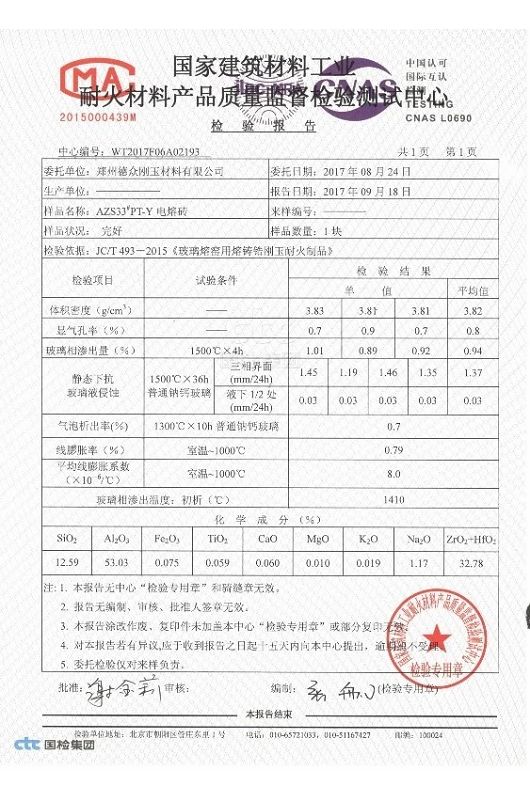
Certificate


Request Technical Evaluation & Project Quotation
Avoid premature lining failure by getting a tailored technical evaluation from Dezhong engineering team.
Please provide the following project details for a precise material recommendation:
1. Furnace Type & Application Zone (e.g., Glass Furnace Bottom, Sidewall, Regenerator)
2. Continuous Operating Temperature & Thermal Cycling Range
3. Material in Contact (e.g., Soda-lime Glass, Borosilicate Glass, Slag Type)
4. Preferred Installation Method (Casting, Gunning, Ramming, or Precast)
5. Current Refractory Specification & Failure History (include photos if available)
FAQ
We are one of the most professional monolithic refractories manufacturers and suppliers in China, specialized in providing high quality customized service for global clients. We warmly welcome you to buy high-grade monolithic refractories made in China here from our factory.


