

High-Performance Sintered Refractories for Industrial Furnaces
Dezhong manufactures high-density sintered refractory shapes and engineered blocks designed for severe thermal, mechanical, and chemical environments in glass, metallurgical, and thermal processing furnaces.
Unlike fused cast refractories, our sintered products combine strictly controlled particle sizing, high-pressure forming, and precision high-temperature sintering. This produces a microstructurally stable ceramic bond tailored for superior thermal shock resistance, low apparent porosity, and high refractoriness under load (RUL).
-
![Lightweight Firebrick]() Lightweight FirebrickLightweight refractory bricks are a type of refractory material with low bulk density, made from lightweight refractory aggregates and special processes. The product possesses excellent thermal
Lightweight FirebrickLightweight refractory bricks are a type of refractory material with low bulk density, made from lightweight refractory aggregates and special processes. The product possesses excellent thermal -
![Insulated Firebrick]() Insulated FirebrickInsulating refractory bricks are lightweight refractory materials that combine fire resistance and thermal insulation properties. Through the use of lightweight aggregates and special production
Insulated FirebrickInsulating refractory bricks are lightweight refractory materials that combine fire resistance and thermal insulation properties. Through the use of lightweight aggregates and special production -
![Insulated Clay Bricks]() Insulated Clay BricksInsulating clay bricks are a type of lightweight refractory material made primarily from refractory clay through a special process. The product features excellent thermal insulation properties and a
Insulated Clay BricksInsulating clay bricks are a type of lightweight refractory material made primarily from refractory clay through a special process. The product features excellent thermal insulation properties and a -
![Hot Face Insulation Bricks]() Hot Face Insulation BricksHot-faced refractory bricks are refractory materials used in direct contact with high-temperature flames or gases. Manufactured using high-quality refractory raw materials, these bricks can withstand
Hot Face Insulation BricksHot-faced refractory bricks are refractory materials used in direct contact with high-temperature flames or gases. Manufactured using high-quality refractory raw materials, these bricks can withstand -
![Fused Silica Brick]() Fused Silica BrickFused Silica Brick is manufactured using high-purity quartz sand as the primary raw material, which is melted in an electric arc furnace and subsequently cast into shape.
Fused Silica BrickFused Silica Brick is manufactured using high-purity quartz sand as the primary raw material, which is melted in an electric arc furnace and subsequently cast into shape. -
![Magnesia Refractory Bricks]() Magnesia Refractory BricksMagnesia refractory bricks are a type of basic refractory material manufactured using high-purity magnesium oxide as the primary raw material. They feature exceptionally high refractoriness and
Magnesia Refractory BricksMagnesia refractory bricks are a type of basic refractory material manufactured using high-purity magnesium oxide as the primary raw material. They feature exceptionally high refractoriness and -
![Chrome Corundum Brick]() Chrome Corundum BrickChrome Corundum Bricks are manufactured using high-purity alumina and chromium oxide as primary raw materials, processed through a high-temperature sintering technique. They exhibit excellent
Chrome Corundum BrickChrome Corundum Bricks are manufactured using high-purity alumina and chromium oxide as primary raw materials, processed through a high-temperature sintering technique. They exhibit excellent -
![Silica Refractory Brick]() Silica Refractory BrickSilica refractory bricks are refractory materials manufactured from high-purity quartz as the primary raw material through high-temperature sintering. They possess excellent high-temperature
Silica Refractory BrickSilica refractory bricks are refractory materials manufactured from high-purity quartz as the primary raw material through high-temperature sintering. They possess excellent high-temperature -
![Alumina Bubble Brick]() Alumina Bubble BrickAlumina Bubble Brick is manufactured using hollow alumina spheres as aggregate and is classified as a lightweight, high-temperature thermal insulation material.
Alumina Bubble BrickAlumina Bubble Brick is manufactured using hollow alumina spheres as aggregate and is classified as a lightweight, high-temperature thermal insulation material. -
![Silicon Carbide Refractory Bricks]() Silicon Carbide Refractory BricksSilicon carbide refractory bricks are manufactured from high-purity silicon carbide as the primary raw material and produced through high-temperature sintering. They feature excellent wear resistance
Silicon Carbide Refractory BricksSilicon carbide refractory bricks are manufactured from high-purity silicon carbide as the primary raw material and produced through high-temperature sintering. They feature excellent wear resistance -
![Sillimanite Brick]() Sillimanite BrickSillimanite bricks are primarily manufactured using natural sillimanite minerals, processed through a high-temperature sintering technique.
Sillimanite BrickSillimanite bricks are primarily manufactured using natural sillimanite minerals, processed through a high-temperature sintering technique. -
![Mullite Insulation Brick]() Mullite Insulation BrickMullite insulation brick is a high-quality refractory material manufactured using high-purity alumina and silica as primary raw materials, and formed through high-temperature sintering to create a
Mullite Insulation BrickMullite insulation brick is a high-quality refractory material manufactured using high-purity alumina and silica as primary raw materials, and formed through high-temperature sintering to create a


Direct Zone Matching & Product Range
|
Material Grade |
Key Raw Base |
Bulk Density (g/cm³) |
Apparent Porosity (%) |
Main Features |
Primary Applications |
|
Sintered Alumina |
High-Purity Al₂O₃ (85% to 99%) |
2.9 to 3.2 |
Less than 18% |
High thermal stability, alkali corrosion resistance |
Burner blocks, furnace upper structures |
|
Sintered Corundum |
α-Al₂O₃ / Electro-Corundum |
3.1 to 3.4 |
Less than 16% |
Exceptional cold crushing strength (CCS) & abrasion resistance |
High-wear charging zones, skid rails, throat channels |
|
Sintered Mullite |
Synthetic / Fused Mullite |
2.5 to 2.8 |
Less than 17% |
Outstanding thermal shock resistance & creep resistance |
Regenerator checkers, crowns, thermal cycling zones |
|
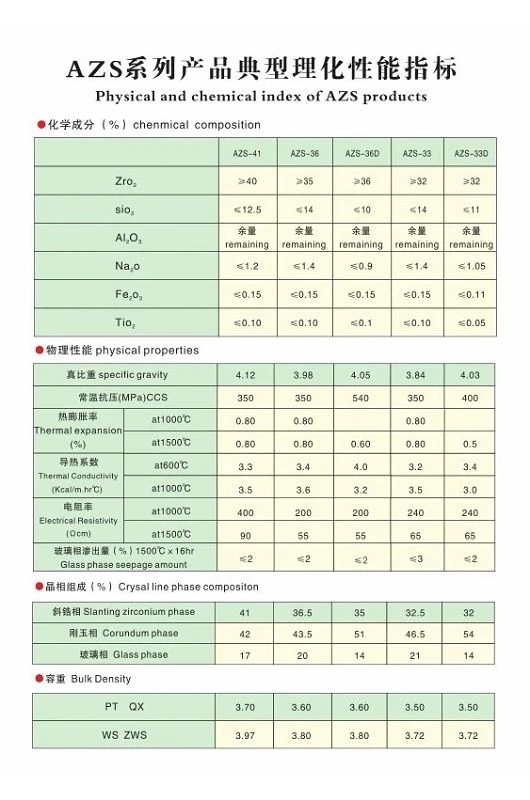
Sintered Zirconia |
Stabilized ZrO₂ |
4.2 to 5.0 |
Less than 15% |
Superior glass-melt corrosion resistance, minimal phase change |
Glass contact zones, feeder expendables, transition layers |
Technical Comparison: Sintered vs. Fused Cast Refractories
|
Factor |
Sintered Refractory |
Fused Cast Refractory |
|
Manufacturing |
Shaped under high pressure and fired below melting point |
Electrically melted and poured into sand/graphite molds |
|
Microstructure |
Engineered crystalline bonds with uniform controlled pores |
Dense, interlocking cast crystalline structure with shrinkage cavities |
|
Thermal Shock Resistance |
High. Lower thermal expansion stress; handles thermal cycling well |
Moderate to Low. Highly susceptible to cracking during rapid thermal shifts |
|
Dimensional Tolerance |
Precise. Easily diamond-machined to tight tolerances (±0.5mm) |
Requires specialized grinding; casting void locations must be managed |
|
Cost & Economics |
Cost-effective for structural zones, checkers, and upper walls |
Higher cost; reserved strictly for high-wear molten glass contact |
Precision Manufacturing & Quality Control
To guarantee dimensional accuracy during site installation, Dezhong enforces a zero-defect manufacturing process:
Raw Material Purity
Strict ICP testing for Fe₂O₃ and alkali impurities to eliminate glass discoloration and premature fluxing.
Homogeneous Batching & High-Pressure Forming
Micro-fine grinding ensures optimal packing density before hydraulic pressing.
Computer-Controlled Firing Schedules
Precise sintering curves prevent internal micro-cracks and ensure complete phase transformation.
Post-Sintering Machining & Dry Assembly
Complex shapes (burner blocks, doghouse arches, feeder parts) are diamond-machined and pre-assembled in-factory to verify tight joint clearances.
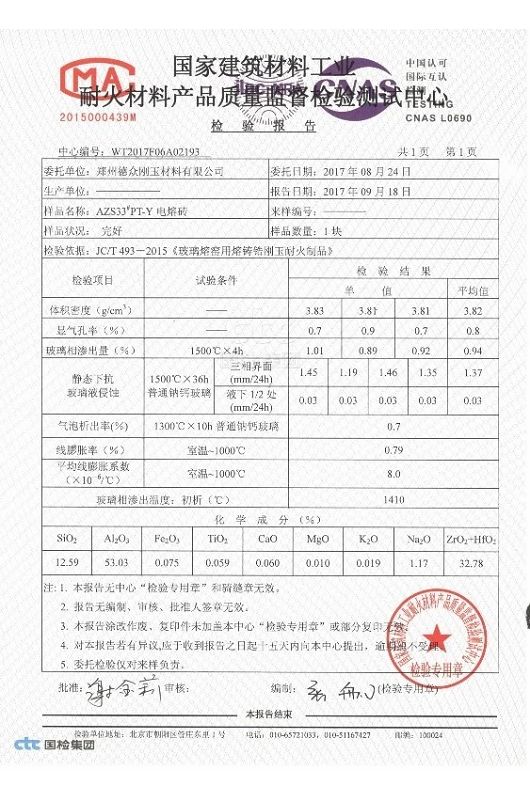
Certificate


Export Packaging & Damage Prevention
Industrial refractories require heavy-duty export packaging to withstand multi-modal sea freight:
Edge Guard Protection
All machined corners are fitted with reinforced corner protectors.
Vapor & Moisture Barriers
Vacuum-sealed plastic wrapping prevents humidity damage during ocean transit.
Custom Fumigated Wooden Crates
Heavy-timber crates reinforced with steel strapping, engineered for forklift and crane handling.
Request a Technical Evaluation & Quotation
Do not select refractories based solely on nominal Al₂O₃ content. Contact Dezhong's engineering team for a site-specific evaluation.
Please share with us:
Furnace drawings or CAD files (including dimensional tolerances).
Operating parameters (continuous temperature, thermal cycle frequency, furnace atmosphere).
Contacting media (glass chemistry, slag composition, or raw batch characteristics).
Current refractory service life and observed failure modes.
FAQ
We are one of the most professional sintered refractory manufacturers and suppliers in China, specialized in providing high quality customized service for global clients. We warmly welcome you to buy high-grade sintered refractory made in China here from our factory.
Low Porosity Fireclay Brick, Sillimanite Brick, Silica Refractory Brick


